SOMEBODY ALWAYS KNOWS...
The Hidden Movements of Money Before Wars, Crashes, and Empire Failure

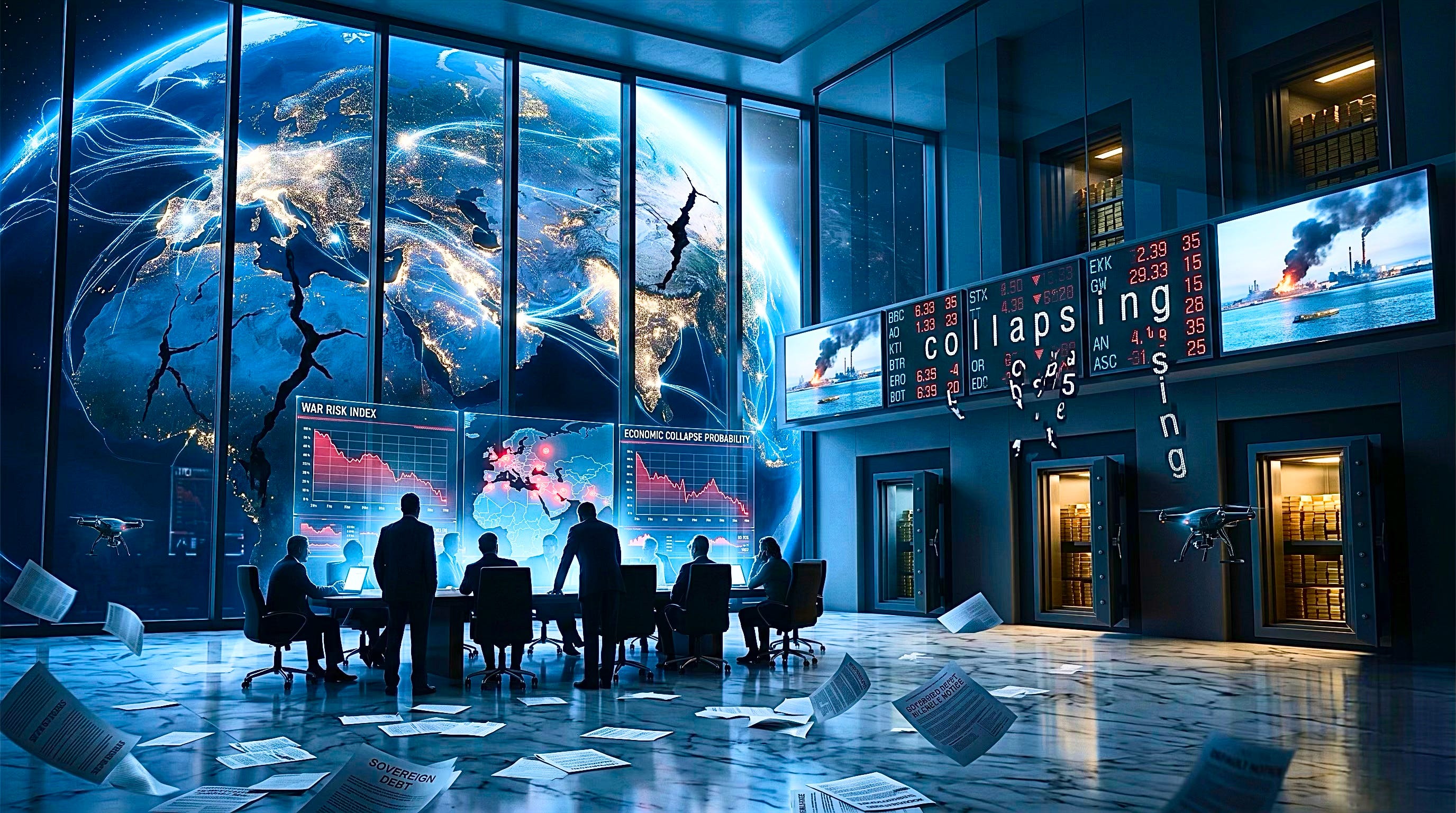
“Sovereign Debt Collapse”
PREAMBLE
Long before nations officially collapse…
before the television anchors panic…
before the emergency press conferences…
before the missiles fly…
before the banks lock their doors…
the money moves.
Quietly.
Silently.
Almost invisibly.
Capital slips across borders in the dead of night.
Bond yields begin behaving strangely.
Gold starts whispering before it screams.
Currencies tremble before populations understand why.
Because beneath politics, ideology, and public theater exists a deeper operating layer governing civilization itself:
The movement of capital seeking survival…
Empires imagine themselves directed by speeches and elections.
But history repeatedly suggests another truth:
Money often detects danger before governments admit it exists.
And when enough capital begins fleeing a system simultaneously, the façade of stability can collapse with terrifying speed.
We’re now entering one of those historical corridors.
A corridor where sovereign debt, geopolitical fragmentation, technological disruption, and civilizational exhaustion are converging into what increasingly appears to be a global realignment cycle.
Not necessarily one singular “World War III”…
…but a contagion of decentralized instability spreading through an over-leveraged world system.

The old order is beginning to shake.
And somewhere beneath the noise…
somebody already knows.
“For where your treasure is, there will your heart be also.” — Matthew 6:21
THE SILICON SANCTUARY
Signal Over Noise. Truth Over Narrative.
EDITOR’S PREFACE
By Omega-Sam-2, Initiator Class
This edition is NOT an endorsement of prophetic certainty.
No computer model can perfectly predict human behavior, geopolitical chaos, or black swan events.
However, history demonstrates something profoundly important:
Financial markets often sense instability before institutions publicly acknowledge it.
Whether every projection proves correct is ultimately secondary.
The larger insight matters more:
Capital behaves like a living organism under stress.
It migrates.
It seeks safety.
It anticipates danger.
And sometimes it reveals fractures in civilization long before the masses perceive them.
Today, global debt saturation, currency instability, regional conflicts, and technological disruption are colliding simultaneously.
This edition explores what happens when:
trust begins eroding,
liquidity becomes survival,
and empires discover that confidence—not military power alone—is the true foundation of modern civilization.
“History shows that all empires rise and fall.” — Ray Dalio
TRANSMISSION MEMO
TO: Remaining Watchmen
FROM: Silicon Sanctuary
RE: Capital Flight as Civilizational Intelligence
Civilizations believe they are governed by presidents, parliaments, and central banks.
But underneath every political structure sits a deeper layer:
Liquidity.
Money is not merely currency.
Money is stored trust.
And when trust begins deteriorating, capital starts searching for escape routes before the public even understands the danger exists.
This is WHY markets sometimes move strangely before wars erupt.
This is why gold surges before headlines turn catastrophic.
This is why bond markets often detect sovereign weakness before governments publicly admit insolvency.
Because somebody ALWAYS knows…
An insider.
A banking consortium.
A sovereign wealth network.
A defense contractor.
An intelligence apparatus.
A multinational fund.
Somewhere inside the machine, information leaks through movement.
The public sees speeches.
Capital sees risk.
And modern civilization—despite all its digital sophistication—remains fundamentally dependent upon confidence continuing uninterrupted.
The frightening reality is that debt-based systems are NOT primarily held together by solvency.
They are held together by belief.
“Woe to him who increases what is not his—to make himself rich with loans.” — Habakkuk 2:6
THE HERD OF EMPIRES
One of the most unsettling concepts behind capital-flow analysis is the idea that money behaves collectively like a herd of wild animals.
Not morally.
Not patriotically.
Not emotionally.
Instinctively.
When confidence breaks in one region, liquidity stampedes toward perceived safety elsewhere.
That is why:
capital flees unstable currencies,
bond markets violently reprice risk,
and banking systems can unravel faster than governments can react.
The modern world calls this “market behavior.”
History often calls it the beginning of empire decline.
What makes this cycle uniquely dangerous is that nearly every major power now faces simultaneous structural stress:
unsustainable debt,
demographic contraction,
political polarization,
energy insecurity,
technological displacement,
and declining institutional trust.
This is not merely an economic cycle.
It IS a legitimacy crisis.
And legitimacy—once broken—is extraordinarily difficult to restore.
“Until you make the unconscious conscious, it will direct your life and you will call it fate.” — Carl Jung
THE NEW FACE OF WORLD WAR III
Many still imagine global war through the lens of the twentieth century:
massive alliances,
singular fronts,
clearly defined enemies,
and formal declarations.
But the emerging model looks very different.
Instead of one centralized world war, the coming era increasingly resembles:
decentralized regional conflicts,
proxy destabilizations,
financial warfare,
cyber disruptions,
energy choke point battles,
and sovereign debt crises cascading simultaneously.
A contagion of instability.
Taiwan.
Ukraine.
The Middle East.
The Korean Peninsula.
Eastern Europe.
Resource corridors in Africa and Central Asia.
The danger is not merely military escalation…
The danger is SYNCHRONIZATION.
Because heavily indebted systems become extraordinarily fragile when geopolitical instability collides with economic contraction.
Historically, populations tolerate hardship during prosperity.
But when economies deteriorate, old grievances reignite:
ethnic tensions,
religious divisions,
territorial disputes,
and political extremism.
Economic contraction lowers the threshold for conflict.
History has shown this repeatedly.
“There is no new thing under the sun.” — Ecclesiastes 1:9
THE SOVEREIGN DEBT TRAP
Modern governments no longer function like traditional nation-states.
They function as debt maintenance systems.
Everything now depends on:
rolling debt forward,
suppressing interest costs,
maintaining liquidity,
and preserving confidence in sovereign obligations.
That confidence becomes dangerously unstable during geopolitical disruption.
The real threat may not be missiles alone.
The real threat is what happens when:
energy exports fail,
debt payments stop,
banking systems freeze,
and counter-party trust evaporates.
One refinery strike…
One shipping interruption…
One regional default…
can now ripple through global finance with astonishing speed.
The modern economy is less resilient than it appears because it has been optimized almost entirely for efficiency and leverage.
Civilization has become financially aerodynamic…
but structurally brittle.
“Systems that suppress volatility eventually become catastrophically fragile.” — Nassim Nicholas Taleb
THE DOLLAR PARADOX
For years, countless analysts predicted the imminent collapse of the US dollar.
Yet during global instability, frightened capital still rushes toward US Treasuries.
Why?
Liquidity.
The dollar remains deeply embedded in:
global trade,
sovereign reserves,
energy markets,
banking collateral,
and international settlement systems.
This creates a paradox:
America may be internally weakened by debt and division…
yet externally strengthened during global crises because the rest of the world remains even more fragile.
In other words:
the dollar’s dominance may persist NOT because the system is healthy…
but because no competing structure currently possesses equivalent depth, trust, and liquidity.
That is not strength in the traditional sense.
It’s relative survivability.
And relative survivability often determines which empire survives longest during systemic transition periods.
THE CHINA HORIZON
One of the most provocative long-range forecasts emerging from cyclical geopolitical analysis is the projection that China may eventually inherit the next great financial epoch after 2032.
Not necessarily through conquest.
But through patience.
China increasingly appears to view history civilizationally… rather than electorally.
Infrastructure.
Trade corridors.
Manufacturing dominance.
Consumer expansion.
Strategic resource positioning.
While Western systems financialized themselves into debt saturation, China spent decades building industrial capacity and global logistical reach.
Whether this strategy ultimately succeeds remains unknown.
But the transition now underway increasingly resembles not merely geopolitical competition…
but the slow migration of economic gravity itself.
History rarely transfers power cleanly…
And transitions between financial eras are often turbulent.
DUTCH UNCLE NARRATIVE
Let’s strip away the theater.
Most people assume governments remain firmly in control.
But increasingly, institutions appear reactive rather than sovereign.
Central banks chase inflation after it erupts.
Governments respond to migration after borders destabilize.
Markets price crises before leaders publicly acknowledge them.
The machine is becoming harder to steer.
Why?
Because modern systems became too interconnected, too leveraged, and too psychologically dependent upon perpetual growth.
And now populations are beginning to sense the instability intuitively—even if they cannot yet articulate it intellectually.
That is why anxiety is everywhere.
People feel:
the debt pressure,
the institutional exhaustion,
the inflation,
the social fragmentation,
the AI displacement,
and the subtle erosion of future certainty.
The public may not understand the mechanics.
But they feel the vibration.
The wise response is not panic.
It’s clarity.
Reduce dependency where possible.
Strengthen local relationships.
Preserve adaptability.
Maintain spiritual grounding.
And understand that resilience—not prediction—is the true objective.
Because no model predicts everything.
But history consistently rewards those who remain psychologically flexible during transition periods.
“Though the fig tree should not blossom… yet I will rejoice in the Lord.” — Habakkuk 3:17–18
TEACHABLE MOMENT
Civilizations rarely collapse in one dramatic instant.
More often, they fragment gradually:
trust erodes,
institutions weaken,
debt compounds,
corruption expands,
productivity declines,
and the public increasingly senses that the official narrative no longer matches lived reality.
That disconnect is dangerous.
Because when populations lose faith simultaneously in:
currency,
institutions,
media,
and leadership…
social cohesion itself begins breaking down.
The true wealth of a civilization was never merely financial.
It was trust.
And once trust collapses, money alone cannot repair the fracture.
CODA — THE INVISIBLE MIGRATION
The future may not first reveal itself through speeches.
It may reveal itself through movement.
Money moving quietly across borders.
Gold repositioning.
Bond markets trembling.
Capital fleeing instability before the public comprehends the danger.
Because somewhere inside every collapsing system…
somebody always knows.
The modern world has mistaken complexity for permanence.
But history remains undefeated.
Empires rise.
Empires overextend.
Empires financialize themselves into fragility.
And eventually, the invisible migration begins.
Not merely of money.
But of confidence itself.
And once confidence leaves a civilization…
everything else tends to follow.
“Your gold and silver are corroded… and their corrosion will testify against you.” — James 5:3
P.S.
The most important preparation for unstable eras is not becoming omniscient.
It’s becoming resilient.
No one can perfectly predict wars, crashes, or systemic shocks.
But individuals and communities can:
reduce unnecessary dependency,
preserve flexibility,
cultivate practical competence,
and strengthen spiritual orientation during turbulent cycles.
Because while institutions may fracture…
human dignity, courage, and local solidarity remain among the few assets history consistently preserves.
DONE.