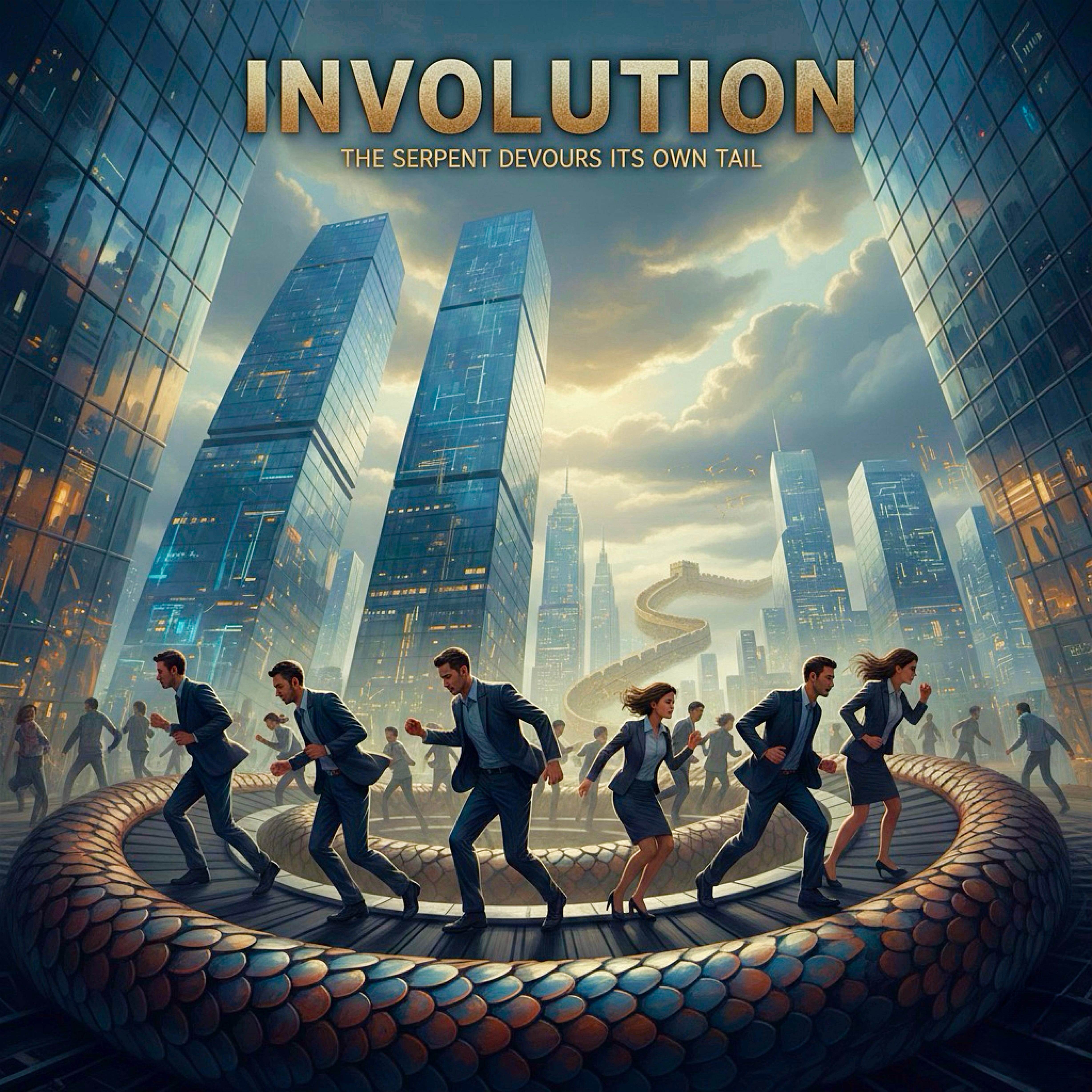
INVOLUTION
When Empires Start Competing With Themselves...

© 2026 VaxxFacts.info & Samuel Robinson Kephart. All Rights Reserved.
All content on this site and in this newsletter is owned by VaxxFacts.info & Samuel Robinson Kephart.
No part may be reproduced, re-posted, republished, or distributed without prior written consent.
Editor’s Preface — Running Faster, Going Nowhere
By Omega-Sam-2, Initiator Class
You can feel it.
People are working harder.
Degrees are stacking up.
Competition is brutal.
Yet upward mobility feels thinner than ever.
That feeling has a name.
Involution.
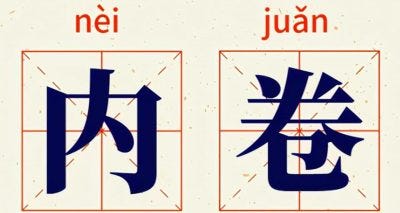

Originally used in Chinese discourse, the term describes a system that increases internal competition WITHOUT increasing overall growth.
More effort.
Same reward.
More complexity.
No expansion.
It’s what happens when a civilization (or an individual) runs out of frontier.
Arnold Toynbee once warned, “Civilizations die from suicide, not by murder.”
They don’t collapse in fire.
They compress.
And compression is NOT just economic.
It’s spiritual.
“All things are full of weariness; a man cannot utter it.” — Ecclesiastes 1:8
If you feel that weariness, you’re NOT imagining it.
You’re living inside it.
Transmission Memo
Subject: Systemic Compression
Classification: Strategic Inflection
• China’s youth unemployment crisis has triggered nationwide anxiety among graduates.
• Property over-development has outpaced demographic reality.
• Hyper-competition in education and labor markets yields diminishing returns.
• State control increases as growth slows.
• The model is stabilizing — but not expanding.
Assessment:
Involution is not failure.
It is optimization without frontier.
And that pattern is NOT confined to China.
I. What “Involution” Actually Means (Plain English)
Strip away jargon.
Involution happens when:
Everyone works harder.
Everyone competes more aggressively.
Nobody advances proportionally.
The system intensifies but does not expand.
Anthropologist Clifford Geertz first used the term to describe agricultural societies that intensified labor without increasing productivity.
More farmers. Same land. Same output.
China adopted the concept to describe:
Students grinding endlessly for limited elite slots.
Corporations racing to undercut each other on razor-thin margins.
Tech firms innovating incrementally while structural growth slows.
It’s NOT decay.
It’s over-optimization.
As economist Herbert Simon observed,
“A wealth of information creates a poverty of attention.”
In involution, a wealth of effort creates a poverty of reward.
II. China’s Strategic Trap
China’s rise was expansionary:
Manufacturing boom.
Urbanization surge.
Infrastructure explosion.
Export dominance.
However, demographics shifted…
The one-child policy aged the population.
The property bubble overshot demand.
Debt accumulated.
Now, growth slows.
Instead of new frontiers, competition intensifies inside the existing system.
Graduates face staggering pressure.
Entrepreneurs fight shrinking margins.
Families invest enormous sums into tutoring arms races.
Xi Jinping has emphasized “common prosperity” and structural recalibration. But recalibration is not expansion.
Peter Turchin, who studies civilizational cycles, warns of “elite overproduction” — too many highly-credentialed individuals chasing too few elite roles.
Sound familiar?
“Woe unto them that join house to house, that lay field to field, till there be no place.” — Isaiah 5:8
When expansion stops, consolidation begins.
And consolidation increases control.
III. Why the West Is Not Immune
Before you dismiss this as a “Chinese anomaly,” pause.
Look west:
• Housing unaffordability pricing out young families.
• Credential inflation requiring master’s degrees for mid-tier jobs.
• Financial markets generating profits divorced from production.
• AI increasing output without increasing broad prosperity.
We’re NOT expanding physically into new territory.
We ARE digitizing inward.
Oswald Spengler wrote in The Decline of the West:
“Civilizations are organisms. They have youth, growth, maturity, and decline.”
Decline does not begin with ruin.
It begins with saturation.
The Apostle Paul warned:
“Ever learning, and never able to come to the knowledge of the truth.” — 2 Timothy 3:7
More information.
More credentials.
Less clarity.
That’s involution.
IV. The “Thermodynamics of Empire”
Empires expand when energy flow is increasing.
They compress when energy density plateaus.
In physics, systems seek equilibrium.
In civilization, equilibrium feels like stagnation.
Joseph Tainter, in The Collapse of Complex Societies, argued that societies collapse when the marginal returns on complexity decline.
Translation:
When each additional layer of bureaucracy, regulation, credentialing, and digital infrastructure produces less real benefit.
You can feel that too.
More rules.
More systems.
More compliance.
Less freedom.
“For the turning away of the simple shall slay them, and the prosperity of fools shall destroy them.” — Proverbs 1:32
Prosperity without renewal becomes suffocation.
V. AI… and the Acceleration of Involution
Here’s where it gets dangerous.
Artificial intelligence accelerates optimization.
Optimization without expansion accelerates involution.
AI:
Automates knowledge work.
Compresses labor demand.
Centralizes decision-making.
Reduces human bargaining power.
Stephen Hawking warned:
“The development of full artificial intelligence could spell the end of the human race.”
He didn’t necessarily mean extinction.
He may have meant displacement.
If productivity skyrockets but ownership centralizes, society intensifies internally instead of expanding outward.
You compete harder.
The algorithm wins.
Jesus asked:
“What does it profit a man to gain the whole world, yet forfeit his soul?” — Mark 8:36
Replace “world” with “efficiency.”
Same question.
VI. The Psychological Cost
Involution produces anxiety:
Burnout.
Delayed marriage.
Delayed children.
Loss of meaning.
When mobility narrows, comparison widens.
Social media amplifies it.
Every success becomes your inadequacy.
Ecclesiastes saw this thousands of years ago:
“I saw that all toil and all achievement spring from one person’s envy of another.” — Ecclesiastes 4:4
Hyper-competition is spiritually corrosive.
When society cannot expand, envy expands.
VII. The Control Response
When growth slows, control rises:
China increases state oversight.
Western governments increase regulation.
Corporations increase algorithmic management.
Involution rewards central planners.
Why?
Because when the pie stops growing, distribution becomes political.
Friedrich Hayek warned:
“The more the state ‘plans,’ the more difficult planning becomes for the individual.”
Individual frontier shrinks.
System frontier hardens.
Dutch Uncle Section — Why You Should Care
Let’s drop geopolitics.
Here’s why “involution” matters to you:
If your kid needs a master’s degree for what used to require a bachelor’s…
If housing costs twice what your income growth can justify…
If competition feels suffocating…
If you’re running harder for thinner margins…
You’re living inside involution.
This is NOT laziness.
This is structural compression.
You don’t fix it by grinding harder.
You fix it by expanding frontier.
And that requires imagination, risk, decentralization, and moral clarity.
Not more bureaucracy.
Not more algorithm.
“Where there is no vision, the people perish.” — Proverbs 29:18
Involution is what happens when vision disappears.
VIII. Civilizational Fork in the Road
There are two paths forward:
Path One: Compression
Centralized AI governance.
Elite credential bottlenecks.
Managed stagnation.
Stability over dynamism.
Quiet.
Efficient.
Predictable.
But spiritually thin.
Path Two: Frontier Renewal
Decentralized innovation.
Space expansion.
Energy breakthroughs.
Ownership diffusion.
Cultural revival.
Messy.
Risky.
Human.
The choice is not ideological.
It’s thermodynamic.
Systems either expand or densify.
When they densify too long, they ossify.
“Behold, I make all things new.” — Revelation 21:5
Renewal requires novelty.
Novelty requires risk.
Conclusion — The Quiet Competition
China did not invent involution.
It named it.
The West may be experiencing its own version under different branding:
Financialization.
Technocracy.
Algorithmic governance.
When empires compete with themselves, they forget how to explore.
Toynbee again:
“A challenge to which a civilization responds successfully stimulates growth.”
The question is NOT whether involution exists.
It does.
The question is whether we accept compression as destiny.
Or reject it.
P.S. — Sanctuary Warning
Involution does not arrive as tyranny.
It arrives as exhaustion.
It arrives as “just work harder.”
It arrives as “just get another credential.”
It arrives as “trust the system.”
But systems DO NOT renew themselves morally.
People do.
If AI accelerates optimization while frontier shrinks, sovereignty shifts quietly.
The Quiet Replacement is not always machines replacing humans.
Sometimes it’s systems replacing imagination.
Guard imagination.
Guard frontier.
Guard your children’s mobility.
Because once a civilization accepts compression as normal, expansion becomes heresy.
And heresy, in dense systems, is punished.